"The Royal Serbian Government not having answered in a satisfactory manner the note of July 23, 1914, presented by the Austro-Hungarian Minister at Belgrade, the Imperial and Royal Government are themselves compelled to see to the safeguarding of their rights and interests, and, with this object, to have recourse to force of arms. Austria-Hungary consequently considers herself henceforward in state of war with Serbia."
-Count Berchtold, Austro-Hungarian Empire declaring war against Serbia, 1914
-Count Berchtold, Austro-Hungarian Empire declaring war against Serbia, 1914
|
During WW1, the Austro-Hungarian Empire occupied Serbia.
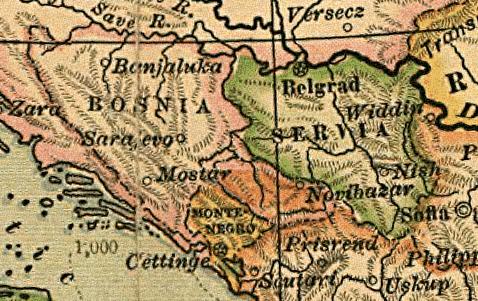
"With its Slav population of just over a million, Serbia was dwarfed by the Habsburg Monarchy to the north, a European great power of some thirty-six millions; yet, in 1914, it was Serbia that the Monarchy attacked, driven to desperation by the threat Serb nationalism posed for its survival. An aggressive, often hysterical Serb nationalism was certainly a major ingredient in the breakdown of relations, since Austria-Hungary (as it was called after 1867) included a sizeable Serb minority among its eleven different nationalities, and Serbs on both sides of the frontier regarded Habsburg rule as oppressive. It was a Serb from Bosnia, the Slav province Austria-Hungary took from Turkey in 1878, who shot the Archduke Franz Ferdinand in the streets of Sarajevo in 1914." -Ian Armour for HistoryToday.com, 1988 Right: Serbia, Bosnia and Montenegro before World War 1 Source UCSB |
|
|
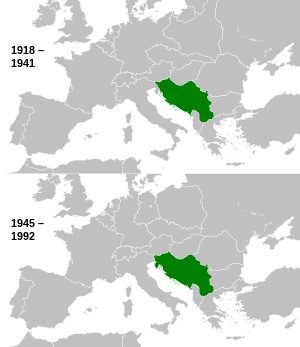
After WW1, Serbia was merged with Montenegro, Kosovo and other territories formerly owned by the Hapsburg Dynasty. This amalgamation of lands became the Kingdom of Yugoslavia, which would be occupied by Nazi Germany in WW2 and become a puppet state of the USSR during the Cold War.
"The Axis powers invaded Yugoslavia on April 6, 1941. The immediate reason for the Axis invasion of Yugoslavia was the Yugoslav government announcement that it would not honor its obligations under an agreement announced on March 25, 1941, by which Yugoslavia joined the Axis and would permit transit through its territory to German troops headed for Greece." -Ushmm.org's Holocaust Encyclopedia, 2014 Left: The border change from 1918 to 1992 Source: Public Domain |